

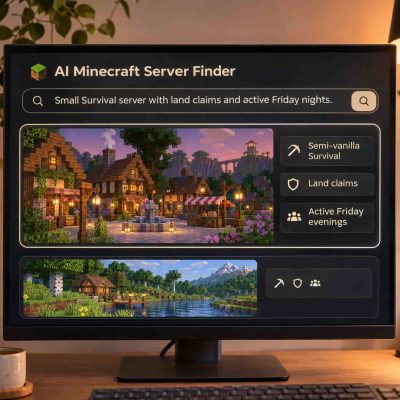
 You want a small Survival server where you can build after work, claim your land, and spend a Saturday evening trading with other players. You filter the listings on Minecraft Menu by Survival and find dozens of options. Some allow raids, others are quiet by the time you log on, and several use the word “vanilla” for very different setups. A proposed AI search feature could build on the directory’s existing tags, sorting, and community voting by turning a description of how you play into a shortlist you can check before joining.
Match Game Modes to What Players Actually Do
A search could start with a sentence such as “I want vanilla-style Survival with friends, occasional events, and no factions.” AI could translate that request into a preferred mode, a tolerance for minor plugins, and a preference for servers that hold events. It could show those interpretations as editable filters. If the player uses “vanilla” to mean no gameplay plugins at all, they can correct the search before browsing the matches.
Mode matching should happen at the world level when the directory has that detail. A network might list Survival, Skyblock, and PvP on the same page. That tells you what the network offers. It leaves open whether its Survival world allows combat or requires a modpack. The directory could keep separate records for each mode and show which world fits the request. It could also check edition and version compatibility up front so Bedrock players see servers they can actually join.
Show Who Plays During Your Usual Hours
A listing can look busy at lunch and feel empty when you join after dinner. To account for that, a directory could collect public player counts at regular intervals and group them by day and hour. Ask players when they usually log on and which time zone they use. Then compare that window with recent activity rather than relying on the latest online count alone.
The results could say, for example, that a network typically shows 15 to 25 players online on Friday evenings during the window you selected. Show the date range and label whether the count covers the network or the specific mode. A player looking for an active Skyblock island community needs that distinction. If the directory has only network-wide counts, it can show that information and mark Skyblock activity as unknown. Owner-posted event times could appear in the player’s local time alongside the activity estimate. For a player who can commit only one evening a week, a recurring event with a published start time may matter more than average activity.
Treat Community Rules as Searchable Details
A description that calls a community friendly leaves questions about what happens in practice. An AI-assisted directory could read public rules and identify policies on PvP, land claims, griefing, trading, and world resets. It could show a plain-language summary beside the source and date checked. Owners could confirm the summary or correct it when policies change. If a listing and its rules page disagree, the directory could flag the discrepancy for review.
Players could choose which rules are essential. Someone who wants to build a town over several months might require land claims and prefer a world with no scheduled reset. A server that resets every season would rank lower for that player, while a server with confirmed open raiding would be excluded if protection is a requirement. If a policy is missing, label it unknown and let the player decide whether to include unconfirmed matches. Moderation quality takes more evidence than a published rules page, so summaries should stick to what the directory can verify.
Explain Why Each Server Appears
Each recommendation could show a few reasons tied to the request. A result might highlight semi-vanilla Survival, land claims, and steady Friday evening activity, then flag that the next reset date is unknown. Another might offer stronger activity during that window but require an application to join. Showing those details up front lets players decide which trade-offs they can live with before copying an address or filling out a form.
The directory could let players edit their priorities without retyping the search. If someone moves “active on weeknights” above “small community,” the order of the results might change. An optional response such as “too competitive” could improve the next search. Players could supply that feedback directly, giving the directory a way to refine recommendations without collecting private chats or tracking what they do in the game.
Give New Listings a Fair Chance
New servers may have detailed rules and the right game mode before they have enough observations to show typical activity. The directory could surface them when their known features fit, with a label explaining how much activity data is available. A community vote total can still help players discover popular options, while the personalized list can give smaller servers visibility when their rules and schedule suit the player.
A useful result should answer three questions before the player joins. Can I play the mode I want? Will people be around when I log on? Do the rules support what I want to do there? AI could pull those answers together, while clear sources and labels help players decide which server is worth trying.